Three reasons why adding carbon maximises nitrogen use in maize
Written by Ellie (Clear).
Published on June 4, 2026
Every penny counts in this year’s maize crop. Pairing foliar nitrogen with a carbon source is one of the fastest ways to lift nitrogen efficiency, reduce plant stress, and turn more of your N spend into yield.
Adding carbon to herbicide and fungicide passes also has advantages – make L-CBF BOOST/Terrafed your go-to tank partner!
Here’s why carbon + nitrogen should be part of every maize nutrition plan this season.
1 – Carbon transforms the efficiency, safety and impact of foliar nitrogen
Over 50% of a maize crop’s nitrogen requirement is post flowering, so applying a late foliar N application has significant benefits. Improving the absorption, conversion and efficiency of the foliar N should also be considered. Foliar urea must be converted into amino acids before the plant can use it. That conversion requires carbon, normally supplied by plant sugars. When the plant has to mobilise its own carbon, it creates an energy deficit — especially under heat, moisture stress or rapid growth.
Adding a carbon source such as L‑CBF BOOST or Terrafed fundamentally changes how well foliar N works:
- More N is converted into amino acids, because carbon is immediately available to drive the biochemical pathway
- Lower scorch risk, especially in hot or bright conditions, because carbon improves the conversion of urea (which can scorch) to amino acids (which don’t scorch)
- Higher Brix levels, because the plant doesn’t have to use as much of its on reserves of sugar keeps the plant sweeter and more resilient to stress, pests and disease
- Better protein formation, because the plant isn’t sacrificing its own energy reserves
- Improved uptake efficiency, meaning more of the foliar N actually becomes yield
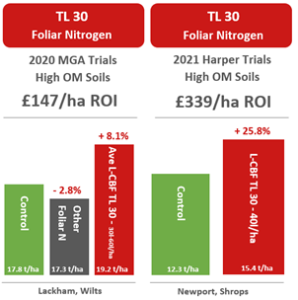
This is where carbon delivers its biggest return: it turns foliar N from a quick fix into a high‑efficiency, low‑stress nitrogen source. QLF Agronomy have two foliar N products which can be used on maize, TL 30 or Amino 15. We can also supply the carbon in the form of L-CFB BOOST or Terrafed to add to your own foliar N. We also stock products for grassland, potatoes and cereals.
2 – Carbon improves herbicide and fungicide performance
Carbon doesn’t just support nitrogen — it also improves the consistency and safety of herbicide and fungicide passes, especially in maize, where crop stress can quickly reduce performance.
Adding a carbon source:
- Buffers spray mixes, reducing the risk of crop scorch or phytotoxicity
- Improves leaf uptake, helping actives move into the plant more efficiently
- Supports plant recovery, supplying energy during periods when chemistry can temporarily slow growth
- Enhances biological resilience, keeping Brix levels higher and reducing stress‑related disease pressure
This makes carbon a simple, low‑cost way to protect crop safety and maximise chemistry performance in every spray pass. Add 5-10l/ha of L-CBF BOOST or Terrafed to your tank mix or even combine with our foliar N products, TL 30 and Amino 15.
3 – Carbon boosts nitrogen efficiency from soil, fertiliser and the season itself
Beyond foliar N and spray passes, carbon plays a crucial role in how maize accesses nitrogen from other sources — applied fertiliser, soil organic matter and mid-season mineralisation. Whilst most crops are now established, there are a few out there that aren’t where growers would like them to be. Spraying some L-CBF BOOST or Terrafed onto the soil can help to give the plant a pick me up!
Here’s how those benefits combine:
- Unlocks more nitrogen from soil organic matter
Soil microbes need a balanced C:N ratio to mineralise nitrogen effectively. Adding carbon fuels microbial activity, increasing additional available nitrogen (AAN) during the warm summer months when maize demand peaks. - Keeps nutrients flowing when fertiliser can’t be applied
Once maize grows above the boom or spinner, granular N applications stop — but crop demand doesn’t. Carbon keeps soil biology active, ensuring a steady release of nutrients during rapid stem extension.
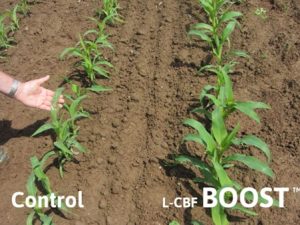
If crops are backward or slow to get away, adding L‑CBF BOOST early helps soil biology activity and rooting, setting the crop up for stronger mid‑season uptake.
Ready to get more from your nitrogen this season?
Whether you want to unlock more nitrogen from the soil, improve the efficiency of foliar N, or support safer spray passes, adding a carbon source is one of the simplest, highest‑impact steps you can take.
Use L‑CBF BOOST to support soil N release and crop recovery, and pair it with our foliar N range for a late‑season nitrogen boost that delivers more protein with less stress.
Let’s build a simple, high‑impact nitrogen plan for your maize.
“Our maize was phenomenal” – Staffordshire farmer Mark Swift shares his experience of using L-CBF BOOST
Staffordshire farmer Mark Swift found that his reliable liquid fertiliser helped save his crop last year.
The farm operates as a family partnership across multiple generations, from parents to grandchildren. They milk around 600 cows, raise all beef calves on-site, and breed their own heifers. Additionally, they lamb 3,500 ewes, purchase another 12 to 15,000 store lambs, and grow maize, wheat, and fodder beet.
Over ten years ago, Mark adopted L-CBF BOOST and has continued using it ever since.
“I tried 60 litres of the stuff. I had three 20-litre drums, and I went down a maize field and put around 20 litres per hectare. The next field was fodder beet, so I went across my fodder beet fields and then down a wheat field, and the results were phenomenal,” Mark says.
“We could see the difference in the maize. You could see the difference in the health of the plant, and there was a definite difference when we were combining the wheat. Ever since then, I’ve been using it.”
“We’ve stuck with it because of that, and doing a top leaf at six and 10 leaves on the maize literally saved us last year.
“Our maize was phenomenal, whereas you went just down the road to someone else’s, and it was about four feet six tall,” he says.
“We’ve definitely seen a yield increase on the maize and on the wheat. Last year, we did slightly over three tonnes, and a lot of the arable farmers around here were struggling even at two and a half. It made a big difference in our yields last year.”